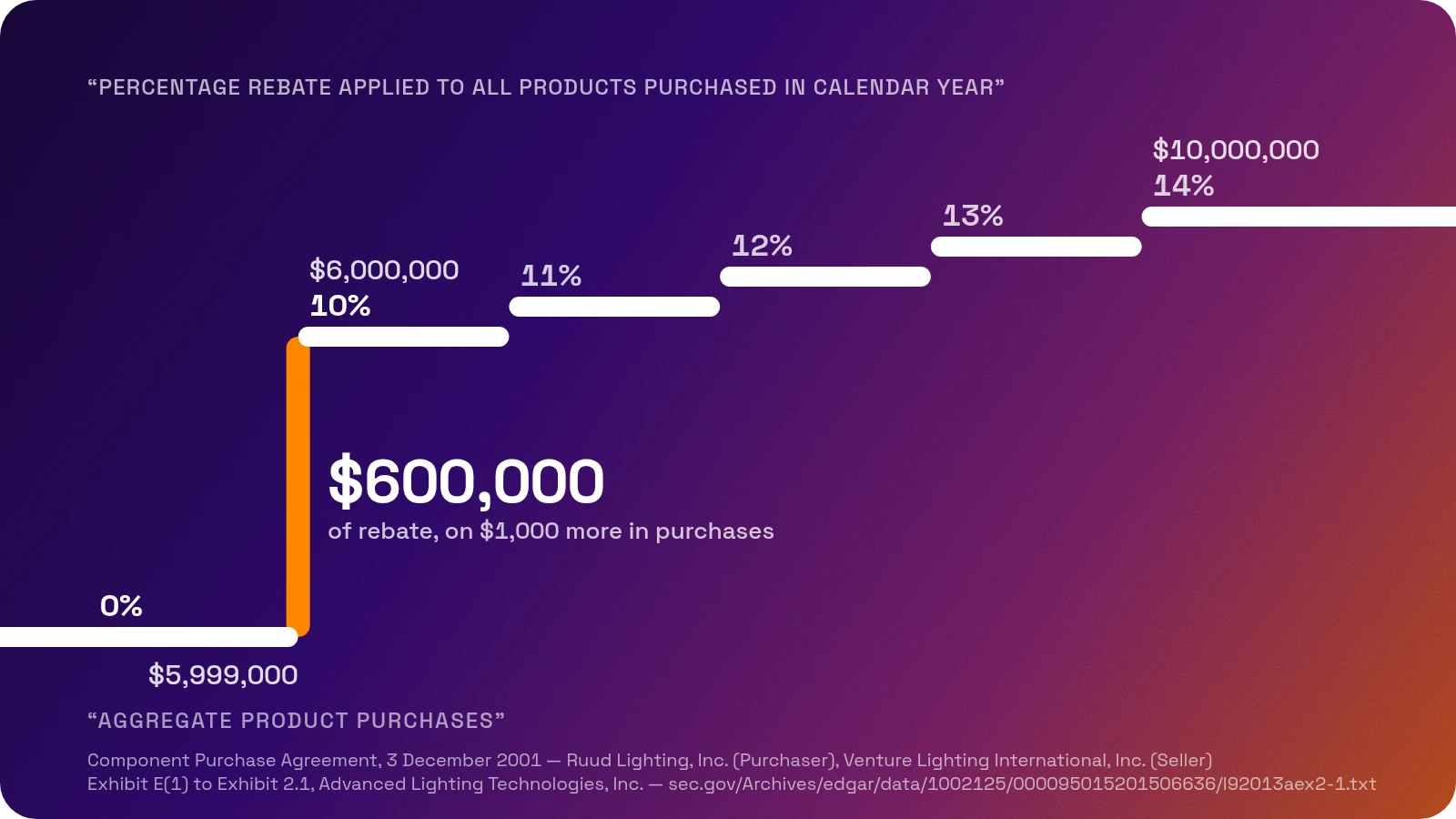
A thousand dollars of buying.Six hundred thousand dollars back.
One supply agreement filed with the SEC pays nothing on $5,999,000 of purchases and $600,000 on $6,000,000, and the reason sits in a single line of the column header.
- 14 minute read
- 10 sections
The document
A five year purchase agreement filed with the SEC in 2001, and the table in section 5.
On 14 November 2001 Advanced Lighting Technologies signed a stock redemption agreement and filed it with the SEC. Bound into that exhibit, as Exhibit E(1), is a five year component purchase agreement between Ruud Lighting of Racine, Wisconsin and Venture Lighting International of Solon, Ohio. Ruud buys high intensity discharge lamps and power supplies. Venture sells them. Section 5 sets the price, and then it sets a rebate.
The sentence that turns the rebate on reads like this.
“In any calendar year in which the aggregate purchase price for Products purchased equals or exceeds $6,000,000, Seller shall credit Purchaser's account within 30 days of the end of such calendar year in the following amounts of the aggregate purchase price paid for Products ("Earned Rebate") during such calendar year:”
What follows is a table with two columns. The left column is headed AGGREGATE PRODUCT PURCHASES. The right column carries the whole argument of this piece, and it is worth reading twice: PERCENTAGE REBATE APPLIED TO ALL PRODUCTS PURCHASED IN CALENDAR YEAR.
The ladder, transcribed from the filing
| Aggregate product purchases | Percentage rebate | Rebate at the bottom of the level |
|---|---|---|
| Up to $5,999,000 | 0% | $0 |
| $6,000,000 to $6,999,999 | 10% | $600,000 |
| $7,000,000 to $7,999,999 | 11% | $770,000 |
| $8,000,000 to $8,999,999 | 12% | $960,000 |
| $9,000,000 to $9,999,999 | 13% | $1,170,000 |
| $10,000,000 or more | 14% | $1,400,000 |
The first two columns are the filing. The third is arithmetic: the rate applied to the purchases at the bottom of each level.
What the table does
The wall at $6,000,000, and the four smaller ones above it that nobody counts.
Read the first two rows together. A year that ends at $5,999,000 of purchases pays nothing at all. A year that ends at $6,000,000 pays ten percent of the whole $6,000,000, which is $600,000.
One thousand dollars of buying, six hundred thousand dollars of rebate.
Rebate earned against purchases made, under the Ruud Lighting table. Five risers, marked with what one more dollar of buying is worth at each. Inside a level the payout climbs, because the rate is paid on everything bought in the year. Exact figures to the cent are in the table below.
The wall at $6,000,000 is the one everybody sees. The four smaller risers above it are the finding. Each higher level is worth one more percentage point, and because that point applies to every dollar bought in the year, each of them is its own cliff.
Every threshold in the table, and what one more dollar of buying is worth at it
| Threshold | Rebate just below it | Rebate at it | The jump |
|---|---|---|---|
| $6,000,000 | $0 | $600,000.00 | $600,000.00 |
| $7,000,000 | $699,999.90 | $770,000.00 | $70,000.10 |
| $8,000,000 | $879,999.89 | $960,000.00 | $80,000.11 |
| $9,000,000 | $1,079,999.88 | $1,170,000.00 | $90,000.12 |
| $10,000,000 | $1,299,999.87 | $1,400,000.00 | $100,000.13 |
Ours, computed from the rates in the filing. Every row below the first moves one dollar of purchases. The first row moves a thousand, because a thousand dollars is the width of the gap the table leaves between $5,999,000 and $6,000,000.
Read the last column. Between $6,999,999 and $7,000,000 there is one dollar of purchases and $70,000.10 of rebate. The same dollar is worth $80,000.11 at the next level, $90,000.12 at the one above that, and $100,000.13 at the top. The table has five cliffs, and four of them are invisible to anybody watching only the headline threshold.
Retroactive, and the drafters say so out loud
The trade has four words for this, and they turn up in filings sixteen years apart.
The mechanism is the column header. The percentage is applied to all products purchased in the calendar year, not to the products bought after the threshold was crossed.
Cross it on 28 December and every invoice back to January is repriced.
The trade has a name for this and it is written into filings. Ace Hardware, which EDGAR classifies under SIC 5070, wholesale hardware, plumbing and heating, puts a three level ladder into its distributor franchise agreement and marks every level the same way.
“Level Three: volume incentive of 1.0% for warehouse purchases back to "dollar one" if Distributor reaches $200,000 in warehouse purchases.”
Back to dollar one is written in quotation marks three times in that paragraph. The drafter is quoting your trade, not inventing a phrase.
Quotation marks, three times in one paragraph. A drafter who puts a phrase in quotation marks is citing somebody else’s language, and the somebody else here is the trade.
Ace filed that agreement in 2003. Sixteen years later the same four words open the programme terms of the 2019 Office Depot Trade Vendor Purchasing Agreement, which is public only because Packaging Corporation of America attached its subsidiary’s signed copy to its own annual report.
“Rebates and allowances for any purchase tiers achieved will be computed back to dollar one ($1).”
We counted how far the phrase travels. EDGAR full text search returns “back to dollar one” in 46 documents from 29 filers, the earliest dated 16 March 2001 and the most recent 2 September 2025, checked on 1 September 2026. That index only reaches back to 2001, so the 2001 date is the floor of the search rather than the floor of the phrase.
Not every one of the 46 is a supplier rebate either, because the same four words do the same job in an earnout and in an insurance deductible. That is the point. It is settled language, used by people who expect to be understood without explaining themselves.
The opposite reading is also normal
Two thirds of the agreements we counted never say which way the rate applies.
A drafter writes “back to dollar one” because the other reading exists. A rebate can pay only on the purchases above the level, in which case crossing it is worth the rate on the excess rather than the rate on the year. On the Ruud table, a year that lands exactly on $6,000,000 pays $600,000 under the first reading and nothing at all under the second, off the same table and the same purchases.
So the question is what your own agreement says. The honest answer, from the corpus described at the foot of this piece, is that most of them never say.
46.5%
of 1,495 agreements set a level or a threshold at all
33.4%
say which way the rate applies once a level is reached, in either direction
52.0%
name a claim window or a deadline after which the money is gone
74.2%
give the supplier the right to audit what you claimed
A third of the corpus says which way it goes. The rest is silent.
Where the paper is silent the question is settled by whoever does the arithmetic.
Usually that is the supplier, because the supplier is the one who sends the statement.
There is also no standard vocabulary to search your own paper for. Across the same corpus the most common phrase for what a rebate is measured against is “net sales”, at 10.5 percent. “Net Purchases”, the phrase most people would assume is the industry term, appears in 3.7 percent. No slot in these agreements has a term that wins.
Before the rate, the base
Three questions decide what the rate gets multiplied by, and the paper answers all three.
A rate applied to the wrong base is wrong at every level of the ladder, and three separate questions sit under the base. All three are decided by the paper rather than by your ERP.
The first is which purchases count. A distribution agreement between Cisco and ScanSource carves an entire ordering channel out of the rebate, so the spend is real and none of it earns a back end rebate.
“For the avoidance of doubt, the price invoiced under the Net Pricing Program is final, and Distributor is not eligible to receive any price adjustments through back-end rebates on purchases under the Net Pricing Program.”
The second is which date puts a purchase inside the period. Office Depot answers it in capitals, which is a fair measure of how often the answer gets ignored.
“PAYMENT TERMS FOR OWNED VENDORS AND VIRTUAL WAREHOUSE VENDORS ARE DETERMINED USING THE DATE OF RECEIPT OF ALL PRODUCTS FROM A PARTICULAR PURCHASE ORDER. INVOICE DATE TERMS ARE NOT ACCEPTED.”
That is one answer out of five, and the other four are all in normal use.
Which date puts a purchase inside the rebate period, as a share of the 1,495 agreements counted. Our count, by the method set out under How this was counted.
A purchase export out of Eclipse or Prophet 21 carries all five of those columns. Picking the wrong one runs your running total against the tier wrong for weeks at a time.
The third is which year a purchase lands in. Ruud’s own section 5 moves a whole month across a year boundary, in a sentence sitting directly under the table, in the kind of language a reader skims.
“All purchases in December 2001 shall be used in the calculating of the Earned Rebate for calendar year 2002.”
One December of buying, moved into the following year by nineteen words. On a table where the first level is worth $600,000, a month in the wrong column decides whether the level is reached.
Earning it and being paid it
The rebate arrives as a credit, the credit waits on your account, and the clock runs anyway.
Section 5 does not stop at the table. The clause that follows makes the credit conditional, and it is the kind of sentence that gets skimmed because it opens with a word people read as boilerplate.
“provided, however, that such account shall not be so credited unless and until all payments have been made necessary to bring Purchaser's accounts current in accordance with their terms.”
The rebate arrives as a credit to an account rather than as a payment, and the credit waits on the account being current. Ace writes the same arrangement from the other end.
“The Company retains the right to apply any rebates earned by Distributor against any amounts past due from Distributor to Company.”
And the window to argue about the figure is short, and in at least one agreement it starts running whether or not anything arrived.
“You must notify Microsoft of any issues regarding the amount of the Rebate Amount issued (or not issued) to you no later than sixty (60) days following your receipt (or failure to receive) a credit for the applicable Rebate Period. You waive any and all right to dispute the amount of a credit if you do not notify Microsoft within such sixty (60) day period.”
Read the words in the brackets. The window closes on a payment that never came, counted from the day it should have come.
The rates themselves are private, on purpose
Six cells of a real rebate chart, printed in the public record as three asterisks each.
The Office Depot agreement is with Boise White Paper, and its pricing exhibit carries a second ladder, written in exactly the language this piece has been tracking.
“Office Depot shall be eligible for an annual rebate, back to dollar one, calculated using a percentage from this chart in accordance with the minimum volume actually purchased in a calendar year:”
Then comes the chart. It has three rows and two columns, headed Rebate Percentage and Minimum Volume (tons), and every one of the six cells is printed as three asterisks in brackets. The exhibit explains itself at the top of the first page: “Certain identified information has been excluded from this exhibit because it both (i) is not material and (ii) would be competitively harmful if publicly disclosed.”
That is the state of the public record. The shape of a programme survives redaction and the numbers do not.
We went looking for the numbers on the other side too, with a domain filtered search across twenty three manufacturer sites in HVAC and plumbing including Rheem, Carrier, Trane, Lennox, Goodman and Daikin. No published distributor rebate schedule on any of them.
The layer that is published is the one aimed at the contractor, because that layer is meant to be seen. The layer aimed at the distributor is the real price of the relationship, and it is usually under a confidentiality clause. Across the corpus, 85.8 percent of these agreements carry one.
Which means nobody can sell you a library of your suppliers’ programmes, and nobody can build one either.
The only copy of your rates that exists is the one in your own filing cabinet.
How this was counted
1,495 agreements counted by machine, and 21 of them read end to end by a person.
The percentages in this piece are ours, and they come from two counts taken separately. The figures given as a share of the corpus are over 1,495 deduplicated contract exhibits from 913 filers, every one of them a document that uses the word rebate.
The agreements read end to end are a second pass: 3,147 documents pulled from EDGAR, cut by detectors to 724 candidates and then to the 293 carrying contract metadata, of which 21 were read in full rather than pattern matched. Of those 21, sixteen measure the rate against the distributor’s purchases rather than against its onward sales, and only three set a flat rate with no level in it at all.
The twenty one split into five economic shapes, which is the number that matters if you ever have to build the arithmetic rather than read it.
Five rate shapes across 21 agreements read in full
| How the rate is set | Agreements |
|---|---|
| Tiered on the absolute level of purchases | 9 |
| Tiered on growth against a prior period | 4 |
| Tiered on the percentage of a target attained | 3 |
| Flat rate | 3 |
| Flat per product line, stacked under a tiered rate | 2 |
Our reading of the 21. A single agreement can carry a stacked shape, which is why the last row exists as its own category rather than as two.
The claim further up about manufacturer websites is a second search and it earns its own line, because a stated absence is as easy to get wrong as a stated figure. It was a domain filtered web search for a published distributor rebate schedule across rheem, carrier, trane, lennox, goodman, daikin, aosmith, bradfordwhite, greenheck, moen, kohler, zurn, watts, nibco, viega, oatey, charlottepipe, apollovalves, libertypumps, zoeller, rectorseal, sioux-chief and mifab. Twenty three domains, and a schedule on none of them.
Nothing here asks you to take those counts on faith. The search that finds the corpus is public and it is linked in the sources below, and so is every document quoted above. Open one and check us.
Who files these, and who does not
Not one of the four companies quoted above sells pipe, and that has to be said out loud.
A note on the evidence. HVAC, plumbing and electrical distributors do not file their supplier agreements with the SEC, because those agreements are not material under Item 601. Ace Hardware and Ruud Lighting are the direct evidence. The rest are agreements of the same shape from other industries. It is the best public evidence there is, and it is not direct evidence of your trade.
Ruud Lighting is a lighting manufacturer buying components. Ace Hardware is a hardware co-operative supplying distributors. Office Depot is a reseller of office products. Cisco sells networking hardware. Not one of them is an HVAC wholesaler.
The reason is Item 601 of Regulation S-K rather than anything about the agreements. A supplier contract has to be material to the filer before it gets attached to a filing, and for a private plumbing distributor nothing gets attached because nothing gets filed. What survives is the shape, from the industries where somebody was obliged to publish it.
Four questions for your own paper
Take the top agreement off the pile. On one agreement this is an afternoon.
None of this needs software to check on a single agreement. Take the top one off the pile and answer four things.
- 1Does the rate reach backwards? Look for “back to dollar one” and for “applied to all”. If neither phrase nor its opposite is anywhere in the document, you are in the two thirds of the corpus that never says, and the answer is whatever your supplier’s statement assumed.
- 2What is the rate measured against? Purchases or sales, gross or net of returns, net of freight, and which brands and product lines are inside the number. The phrase will not be the one you expect.
- 3Which date puts a purchase in the period? Receipt, invoice, payment, shipment or purchase order, and what the agreement does with the weeks either side of the period end.
- 4How long do you have to claim, and from when? Half of these agreements set a window. Read whether the clock starts on the sale, on the statement, or on the day a credit failed to arrive.
On one agreement that is an afternoon. The reason it does not get done is that a distributor doing $20M to $200M has forty of them, each written by a different lawyer, each measuring a different thing over a different year.
Every document this piece is built on
- 01Ruud Lighting supply terms, Exhibit 2.1, SEC EDGARRead 1 September 2026
- 02Ace Hardware distributor franchise agreement, SEC EDGARRead 1 September 2026
- 03Office Depot 2019 Trade Vendor Purchasing Agreement, Exhibit 10.11, SEC EDGARRead 1 September 2026
- 04SEC EDGAR full text searchRead 1 September 2026
- 05Cisco / ScanSource distribution agreement, Exhibit 10.59Read 1 September 2026
- 06Microsoft Services Provider License Agreement, Exhibit 10.115, SEC EDGARRead 1 September 2026
- 07Our count across 1,495 agreements, built from SEC EDGAR full text searchRead 1 September 2026
Forty agreements, forty tables, one statement a month from each.
Send one supplier statement and the purchase export for the same period. We read the agreement behind it, match every line against what you bought, and send back the difference with the clause under each figure.
The first pass is free while we onboard the first ten distributors.